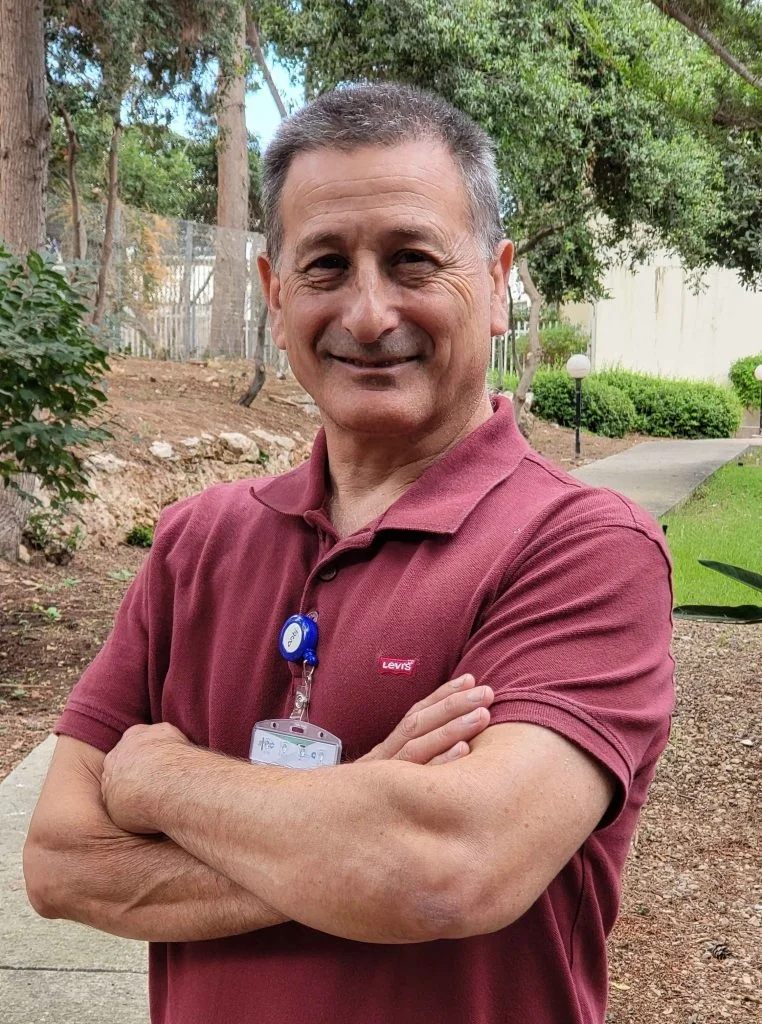
 By Dr. Avi Chezar, shoulder surgeon
Goals of rehabilitation
- Protecting the integrity of the surgical repair in the first stage
- Reducing pain and inflammation and restoring passive range of motion
- Gradually achieving full active movement
- Strengthening the shoulder muscles and returning to daily and sporting activity
Important rules throughout rehabilitation
- Arm in a sling for the first 4 weeks – also at rest
- Do the exercises 3 times a day on your own
- Use local heat before exercising and cold afterwards
- Do not move on to the next stage without reaching the goals of the current one
- Until 3 months after surgery – do not work into significant pain
- For any question you can contact us: 052-422-4623
Rehabilitation timeline
| Stage | Weeks |
|---|---|
| Rest | 0–4 |
| Passive movement | 5–10 |
| Active movement | 11–18 |
| Early strengthening | 19–25 |
| Advanced strengthening | 25–30 |
The stages of rehabilitation
Stage 1: Rest – weeks 0–4 | arm in a sling
Goals of this stage
- Protecting the integrity of the surgical repair
- Reducing pain and inflammation
- Keeping the ability to perform activities of daily living (ADL)
Exercises – 3 times a day
- Pendulum movements – standing, bent forward 90°. The arm hangs and swings gently forwards and backwards and in circles.
- Wrist and finger movement (AROM) – 3 times a day
- Biceps activation – bending the elbow without any resistance
- Isometric activation of the scapular (shoulder blade) and neck muscles
- Cold compresses – as much as possible in the first days; after that, after each exercise session or as needed
Precautions – mandatory
- Pendulum movements only! – no active movements (AROM) of the shoulder
- Do not lift objects with the operated arm
- No stretching or sudden movements
- Do not lean or put weight on the operated arm
- Removing the sling is allowed only for exercises, and at rest as comfortable
Stage 2: Passive movement (PROM) – weeks 5–10 | sling removed
Second clinic review: 3 months after surgery
Passive range-of-motion (PROM) goals
- Forward flexion – up to 140°
- Abduction – up to 90°
- External rotation – up to 50°
- Internal rotation – hand behind the back
How to do it
- Start lying down, with AAROM (active-assisted movement)
- Use local heat before exercising and cold afterwards
- Progress gradually, according to how it feels and the level of pain
Precautions
- Passive movements only – do not force the range of motion
- Do not move on to the active stage if a reasonable passive range of motion has not been reached
- If the active range has not been reached – continue stretching exercises until the goals are reached
Stage 3: Active movement (AROM) – weeks 11–18 | from AAROM to full AROM
Third clinic review: 5 months after surgery
Goals of this stage
- Allow the soft tissues to heal while avoiding excess tension on the repair
- Reach a full active range (AROM)
- Reduce pain and inflammation
How to do it
- At first: AAROM only (active-assisted movement) – taught lying down
- As movement improves – you can move on to full AROM
- Goal: reach an active range similar to the passive range achieved
- Until 3 months after surgery – do not work into significant pain; after that, mild pain is allowed
Precautions
- Active movements with mild pain only
- Start active-assisted and progress gradually
- No sudden movements
- Do not lean or put weight on the operated arm
- Do not progress to the strengthening stage before reaching as full an active range as possible
Stage 4: Early strengthening – weeks 19–25 | bands and movements against gravity
Goals of this stage
- Maintaining the full range of motion achieved
- Gradually restoring strength in the shoulder muscles
- Gradually returning to daily activity
Exercises
- Elastic bands (Theraband) and strengthening aids – as instructed by the physiotherapist
- Abduction with the thumb pointing up – external rotation of the arm while lifting (protects the cuff mechanism)
- Lying on the stomach: abduction and extension of the shoulder
- Elbow activation – bending and straightening
- Activities of daily living (ADL) as able
Precautions
- Only once an active range similar to the passive range has been reached may you progress to strengthening
- Increase the intensity of the exercises gradually
Stage 5: Advanced strengthening – weeks 25–30 | return to activity
Goals of this stage
- Gradual return to full activity
Exercises
- If a full range of motion has not been reached – complete it at this stage
- Strengthening the shoulder muscles – with gradually increasing resistance
- Proprioceptive training – balance training and joint position sense
- Return to gentle sporting activity → gradually back to full activity
Precautions
- Do not lift more than 3 kg
- No sudden lifting or sudden movements
- Do not lift objects above head height without approval
Official document
The official protocol document is in Hebrew: view the full document (PDF, Hebrew).
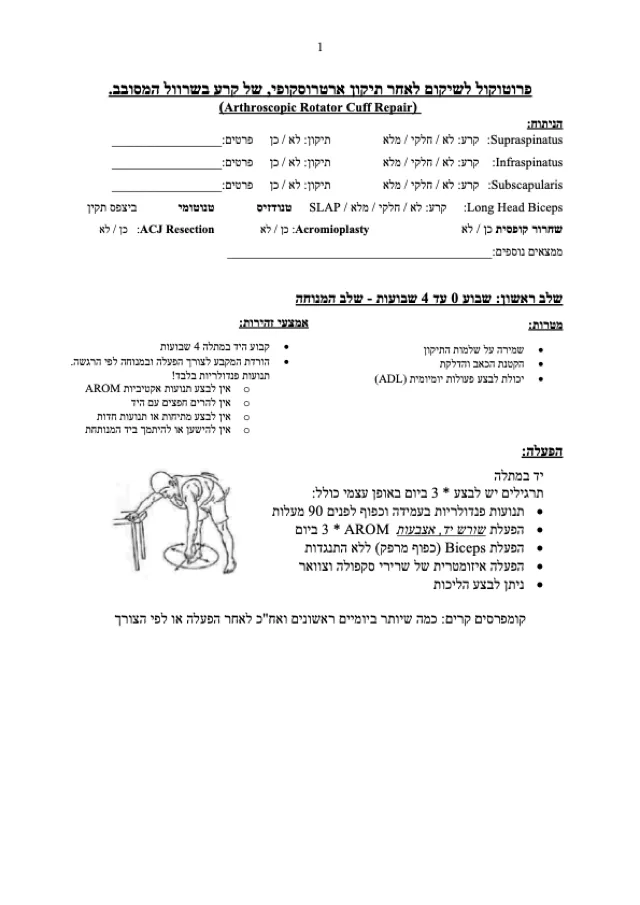 Official protocol documentPage 1 of the full protocol, in Hebrew (PDF).Open the PDF →
Planned clinic reviews
- First review – 2 weeks after surgery – removal of stitches
- Second review – 3 months after surgery – progress check
- Third review – 5 months after surgery – confirming range of motion
The review dates may change at the treating physician's discretion.
When should you contact a doctor?
- Fever above 38°C
- Pain that is not relieved by painkillers
- Heavy discharge from the wound
- Sudden swelling of the arm
- New numbness in the hand
Further reading from leading medical sources
For readers who want to go deeper, here are reliable sources from the American Academy of Orthopaedic Surgeons (AAOS – OrthoInfo):
- Rotator Cuff & Shoulder Conditioning Program — OrthoInfo (AAOS)A structured exercise program for strengthening and rehabilitating the shoulder and rotator cuff
- Conditioning Program — full exercise guide (PDF · AAOS 2025)The illustrated exercise booklet to download and print – PDF file
External sources in English · open in a new tab