Purpose of the protocol
To work gradually with exercises that strengthen the deltoid muscle and improve active shoulder function – with controlled progression between levels of effort.
How to progress
- The exercises are done in sets of 10 repetitions – 2 sets at first, and later 3 sets.
- At every stage, start without a weight. As strength and movement improve, do the same exercises with a ½ kg weight.
- When you can do the exercise easily with the weight, you can move on to the next stage – again starting without a weight and progressing to working with a weight.
The stages of rehabilitation
Stage 1: Exercises lying down – passive and active
Lying on your back with the head supported
Goal of this stage
- Starting active use of the deltoid muscle and improving range of motion
How to do it – 3 sub-stages
- a. Passive: take the affected arm and, with the help of the healthy arm, lift it to 90°. Let go of the arm and try to hold it in this position using the strength of the affected arm.
- b. Active-assisted: move the arm up and down using the strength of the affected arm, with light help from the healthy arm. Do this continuously for about 5 minutes.
- c. Fully active: as function improves, move the arm up and down without any help from the healthy arm. Do this continuously for about 5 minutes.
Precautions
- Keep the movements controlled and slow
- Stop if there is acute pain
Stage 2: Active movements with a weight, lying down
Lying on your back with the head supported
Goal of this stage
- Strengthening the deltoid muscle against light resistance (½ kg)
How to do it
- Lying down with the head supported, raise and lower the arm holding a weight of up to ½ kg.
- Dose: 3 sets of 10 repetitions.
Precautions
- Do not move on to the next stage until you can do this exercise correctly and easily with ½ kg
- Slow, controlled movement – avoid swinging
Stage 3: Half-sitting – raising the arm to the side
Half-sitting (for example on the edge of the bed)
Goal of this stage
- Improving strength against gravity in a semi-upright position
How to do it – 3 sub-stages
- a. Assisted: raise the arm to the side with the help of the other arm, try to hold the position, and then lower it slowly without help.
- b. Unassisted: raise and lower the arm to the side without any help – 10 repetitions per set.
- c. With a weight: when you can do sets of 10 repetitions easily, you can progress to a weight of up to ½ kg.
Precautions
- Keep a good posture and a slow, controlled movement
Stage 4: Standing
Standing – preferably with your back against a wall and knees bent
Goal of this stage
- Returning to full function against gravity while standing
How to do it – 3 sub-stages
- a. Assisted: raise the arm with the help of the healthy arm.
- b. Unassisted: raise the arm fully without any help.
- c. With a weight: lift a light weight of up to ½ kg – 10 repetitions, 2–3 sets each time.
Precautions
- It is recommended to lean your back against the wall with your knees bent, for support and stability
Extra exercise: pushing upwards (isometric)
Can be added at any stage – static strengthening
Goal of the exercise
- Static (isometric) strengthening of the deltoid muscle without moving the joint
How to do it
- Make a fist with the affected hand.
- Place the healthy hand on top of the fist.
- Push the affected hand upwards against the resistance of the healthy hand – the joint does not move.
Precautions
- Do not hold your breath during the effort – breathe normally
Official document
The official protocol document is in Hebrew: view the full document (PDF, Hebrew).
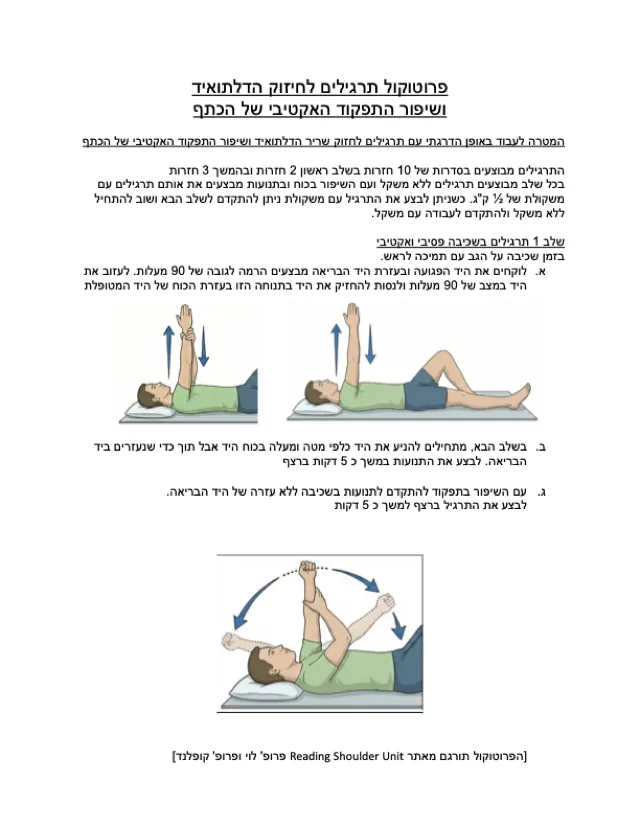 Official protocol documentPage 1 of the full protocol, in Hebrew (PDF).Open the PDF →
Progression ladder
- Without a weight – free movement
- With a ½ kg weight → when the weight feels light, move on to the next stage
At every new stage, start without a weight and progress again.
When should you contact a doctor?
- Fever above 38°C
- Pain that is not relieved by painkillers
- Heavy discharge from the wound
Further reading from leading medical sources
For readers who want to go deeper, here are reliable sources from the American Academy of Orthopaedic Surgeons (AAOS – OrthoInfo):
- Rotator Cuff & Shoulder Conditioning Program — OrthoInfo (AAOS)A structured exercise program for strengthening and rehabilitating the shoulder and rotator cuff
- Conditioning Program — full exercise guide (PDF · AAOS 2025)The illustrated exercise booklet to download and print – PDF file
External sources in English · open in a new tab