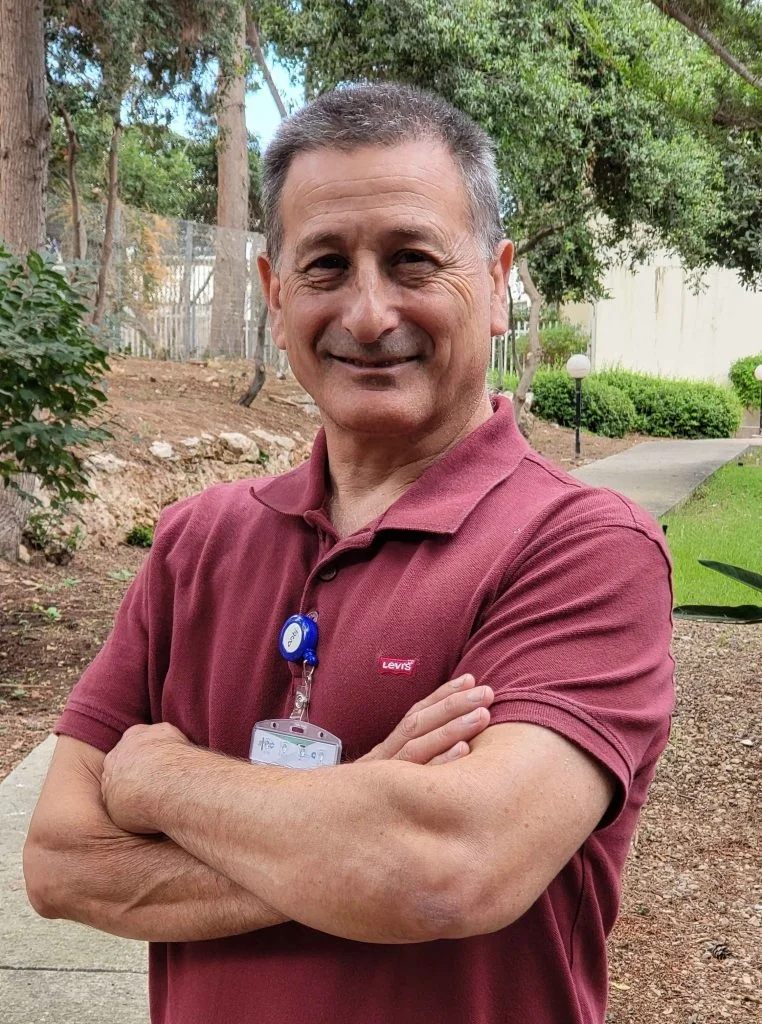
 By Dr. Avi Chezar, shoulder surgeon
Basic anatomy terms
Tendon גיד
Tissue that connects a muscle to a bone. The shoulder has four main tendons, called the "rotator cuff". Their role is to stabilize and move the shoulder.
Bursa בורסה
A fluid sac that reduces friction between a tendon and a bone. Inflammation of a bursa is called "bursitis".
Rotator cuff שרוול מסובב
The group of four muscles and tendons that stabilize the shoulder joint and allow lifting, rotation and complex movements. It includes: supraspinatus, infraspinatus, teres minor and subscapularis.
Supraspinatus על־קוצי
A rotator cuff muscle that starts in the supraspinatus fossa of the shoulder blade and attaches to the greater tuberosity of the humerus. Responsible for lifting the arm from 0 to 15 degrees.
Infraspinatus תת־קוצי
A muscle that originates in the infraspinatus fossa at the back of the shoulder blade and attaches to the greater tuberosity of the humerus. Its role: external rotation of the arm.
Teres minor עגול קטן
A rotator cuff muscle that starts at the lateral border of the shoulder blade and attaches to the humerus. It performs external rotation and adduction. Supplied by the axillary nerve.
Subscapularis תת־שכמתי
The large front muscle of the rotator cuff. It starts in the subscapular fossa (the front of the shoulder blade) and attaches to the lesser tuberosity of the humerus. It performs internal rotation and adduction. Supplied by the subscapular nerves.
Labrum לברום
Fibrocartilage tissue that deepens the shoulder socket (glenoid) and contributes to the stability of the joint. Tears cause instability.
Glenoid גלנואיד
The socket of the shoulder joint on the shoulder blade. It may suffer bone loss with recurrent dislocations.
Humeral head ראש עצם הזרוע
The ball-shaped part of the humerus that forms the shoulder joint. It may break, wear or be damaged in dislocations.
Acromion אקרומיון
The extension of the shoulder blade that forms the "roof of the shoulder". It plays a part in impingement syndrome and in the need for decompression surgery.
Subacromial bursa בורסה סוב־אקרומיאלית
A fluid sac between the deltoid and the head of the humerus that extends under the acromion. It reduces friction. It may become inflamed (bursitis).
AC joint מפרק אקרומיוקלויקולרי
The joint between the acromion and the collarbone. Pain, inflammation and dislocations are common there.
Biceps tendon גיד הביצפס הארוך
A tendon that runs at the base of the shoulder joint. It may tear as a result of trauma or wear. A full tear sometimes creates a "Popeye sign".
Superior labrum biceps anchor
The point where the biceps tendon attaches to the upper labrum – the area where a SLAP tear occurs.
Greater tuberosity גבשושית גדולה
The attachment area of the supraspinatus and infraspinatus tendons. It is affected in fractures and in large tears.
Lesser tuberosity גבשושית קטנה
The attachment area of the subscapularis tendon.
Common medical conditions
Bankart lesion קרע בנקרט
A tear of the anterior-inferior labrum caused by an anterior shoulder dislocation. It does not heal on its own. It causes chronic instability.
SLAP lesion קרע בלברום העליון
A tear at the area where the biceps tendon attaches to the upper labrum. Common after a fall on an outstretched arm and in athletes who perform overhead movements.
Hill-Sachs lesion
A bony compression dent in the head of the humerus, formed when it catches on the rim of the glenoid during an anterior dislocation.
Frozen shoulder כתף קפואה
Inflammation and stiffening of the shoulder joint capsule, leading to severe restriction of movement. Stages: freezing → frozen → thawing. Usually a self-limiting condition.
Adhesive capsulitis
The medical name for frozen shoulder. It includes initial inflammation, thickening of the capsule and severe stiffness.
Rotator cuff tear קרע בשרוול מסובב
A partial or full tear in one of the rotator cuff tendons. Caused by wear, inflammation or trauma. It shows itself as pain, weakness and restriction.
Massive rotator cuff tear קרע מסיבי
A large tear affecting several tendons, usually with tendon retraction and fatty degeneration. It significantly affects function.
Calcific tendonitis הסתיידויות בגידים
Calcium deposits inside the rotator cuff tendons (mainly the supraspinatus). They cause acute pain, or chronic pain and restriction.
ACJ dislocation פריקת המפרק בין הבריח לאקרומיון
A tear of the ligaments that hold the joint. Caused by a fall on a tucked-in arm. Common in athletes.
Shoulder osteoarthritis שחיקת סחוס בכתף
Degeneration of the shoulder joint causing pain, grinding and restriction.
Glenohumeral instability חוסר יציבות של הכתף
A condition of recurrent dislocations or a feeling that the shoulder is "about to come out". Usually caused by a labral tear.
Glenoid bone loss חסר עצם בגלנואיד
Wear or loss of bone at the front, caused by recurrent dislocations. It determines whether a Bankart or a Latarjet is needed.
Humerus fracture שבר בהומרוס
A partial or complete fracture of the upper arm bone. It can be proximal, diaphyseal or distal. It limits movement and causes pain and swelling.
Proximal humerus fracture שבר בחלק העליון של ההומרוס
A fracture of the head of the humerus or of the tuberosities. Common in older age. Treatment ranges from a sling, to a plate and screws, to shoulder replacement.
Impingement צביטה תת-אקרומיאלית
A syndrome in which the shoulder tendons are "squeezed" between the humerus and the acromion. It causes pain when lifting the arm.
Bursitis בורסיטיס
Inflammation of a bursa. It causes pain when lifting the arm, usually in the acute stage.
Biceps tendon rupture קרע של גיד הבייספס
A tear of the long head of the biceps muscle. It causes a "Popeye ball" and sometimes sharp pain.
Tests and diagnosis
Shoulder ultrasound אולטרסאונד כתף
An imaging test that shows tendons, bursae and inflammation in real time. Good for tears and for calcium deposits.
MRI
A non-invasive medical imaging test that uses a strong magnetic field and radio waves to create detailed images of internal organs, soft tissues, bones and blood vessels. Unlike other imaging methods such as X-ray or CT, MRI does not use ionizing radiation, which makes it relatively safe even for pregnant women. The images can be three-dimensional and help diagnose a wide range of medical conditions.
MRI arthrography MRI ארתרוגרפיה
An MRI with contrast injected into the joint – increases accuracy in diagnosing labral tears.
CT (computed tomography) טומוגרפיה ממוחשבת
An advanced medical imaging method that uses X-rays and computer processing to create detailed cross-sectional images of the inside of the body. It lets doctors see internal structures such as bones, soft tissues and blood vessels more accurately than a regular X-ray, and so helps diagnose a wide range of diseases and medical conditions.
Range-of-motion tests (ROM) בדיקות תנועה
Measurements of the range of movement – especially diagnostic in frozen shoulder and in tears.
Apprehension test מבחן חרדה
A test in which the patient feels that the shoulder is "coming out". Positive in anterior dislocations.
Non-surgical treatments
Physiotherapy פיזיותרפיה
The main treatment for most shoulder problems. Physiotherapy is a paramedical profession that deals with the diagnosis, treatment, rehabilitation and prevention of problems of the body's movement system, using various methods such as therapeutic exercise and manual therapy. Its main aim is to improve or maintain the patient's functional ability and reduce pain, so as to return them to the best possible daily function.
Subacromial / intra-articular injection הזרקה סוב-אקרומיאלית / תוך מפרקית
An injection of steroids or hyaluronic acid to reduce inflammation and pain.
Anti-inflammatory drugs (NSAIDs) תרופות נוגדות דלקת
A family of drugs used to relieve pain, reduce fever and reduce inflammation in the body. They work by inhibiting enzymes involved in producing chemicals (prostaglandins) that cause pain and inflammation, and they are distinct from the steroid family of drugs. Ibuprofen, Etopan, Arcoxia – to reduce inflammatory pain.
Dedicated rehabilitation after surgery שיקום ייעודי אחרי ניתוח
A gradual program to improve strength, movement and stability – it directly affects the results of surgery.
Surgical treatments
Reverse shoulder replacement כתף הפוכה
An implant in which the humerus and glenoid are replaced in a reversed configuration. Suitable for massive tears or severe wear without a functioning rotator cuff.
Anatomical shoulder replacement החלפת כתף אנטומית
An implant that mimics the natural structure of the shoulder. Intended for when the rotator cuff is intact.
Latarjet procedure ניתוח לטרזה
Transfer of the coracoid bone to the front of the glenoid to create a bony and dynamic barrier. The best treatment for recurrent dislocations with bone loss.
Bankart repair תפירת לברום
Arthroscopic repair of a Bankart tear using anchors. Treatment for recurrent dislocations without significant bone loss.
Remplissage רמפילאז'
Fixing the shoulder capsule into a Hill-Sachs lesion to stop the head from engaging on the glenoid during a dislocation.
Arthroscopy ארתרוסקופיה
Minimally invasive surgery using a camera and small instruments. Used to diagnose and treat tears, calcifications and dislocations.
Tendon repair תפירת גיד
Restoring a torn tendon and reattaching it to the bone with anchors – mainly in rotator cuff tears.
Tenotomy טנוטומי
Controlled cutting of a tendon (usually the biceps tendon) to relieve pain. Usually intended for older patients or those with severe tears.
Tenodesis טנודזיס
Reattaching the biceps tendon to the bone outside the joint. Particularly suitable for young people and athletes.
Other important terms
Internal rotation רוטציה פנימית
Rotating the arm towards the body. Mainly affected in subscapularis tears.
External rotation רוטציה חיצונית
Rotating the arm outwards. Affected in infraspinatus and teres minor tears.
No matching terms. Try a different word.
Have more questions?
I will be happy to answer any question and give professional advice.