 By Dr. Avi Chezar, shoulder surgeon
Purpose of the protocol
To strengthen the rotator cuff muscles except the supraspinatus, so as to allow proper healing of the tendon. It also strengthens the shoulder stabilizers: the deltoid and trapezius.
General principles
- Some of the exercises require a Theraband (elastic exercise band).
- Choose the color according to the level of difficulty you need – adjusted individually. A band 1.20–1.50 m long is recommended.
- The exercises are done with the elbows held against the body.
- Do the exercises 3 times a day, 10–15 repetitions of each exercise – and hold the band stretched for 3–5 seconds in each repetition.
The strengthening exercises
1. External rotation with a Theraband attached to the wall
Purpose
- Strengthening the external rotator muscles of the shoulder (infraspinatus, teres minor)
How to do it
- Attach the band to the wall at elbow height.
- Start with the elbow bent at 90° and held against the body.
- Rotate outwards – move the forearm away from the body – until the band is fully stretched.
- Hold the stretched position for 3–5 seconds, then slowly return to the starting position.
- You can start with the exercise against a wall (without a band) and progress to the exercise with a weight.
Precautions
- Keep the elbow against the body throughout the exercise.
- Do not push beyond the limit of pain.
2. Internal rotation with a Theraband attached to the wall
Purpose
- Strengthening the internal rotator muscles of the shoulder (subscapularis)
How to do it
- Attach the band to the wall at elbow height and stand side-on (the affected side away from the wall).
- Start with the elbow bent at 90° and held against the body.
- Rotate inwards – bring the forearm towards the abdomen – until the band is fully stretched.
- Hold the stretched position for 3–5 seconds, then slowly return to the starting position.
- Once you have good control, you can progress to the exercise with a weight.
Precautions
- Keep the elbow against the body throughout the exercise.
- Slow, controlled movement – avoid swinging.
3. Deltoid strengthening – anterior, middle and posterior
Light lifting only – up to the limit of pain
Purpose
- Strengthening all three parts of the deltoid muscle: anterior, middle and posterior
The three exercises
- Anterior deltoid – forward raise (Anterior Raise): raise the arm forward in a straight movement, up to shoulder height. Hold 3–5 seconds and lower slowly.
- Middle deltoid – side raise (Lateral Raise): raise the arm to the side up to shoulder height. Hold 3–5 seconds and lower slowly.
- Posterior deltoid – backward extension (Posterior Extension): raise the arm backwards in a controlled movement. Hold 3–5 seconds and lower slowly.
Precautions
- Light lifting only – up to the limit of pain, without forcing.
- You can do the exercises without a weight at first and progress gradually.
- Slow, controlled movement in both directions.
4. Additional exercises as instructed by the physiotherapist
Note
- Additional, individually adjusted exercises will be given at the discretion of the treating physiotherapist.
- Progression between difficulty levels depends on strength and pain – keep the treating team informed.
- The protocol is provided by: Dr. Avi Chezar – Shoulder Service, Department of Orthopedics, Emek Medical Center.
Official document
The official protocol document is in Hebrew: view the full document (PDF, Hebrew).
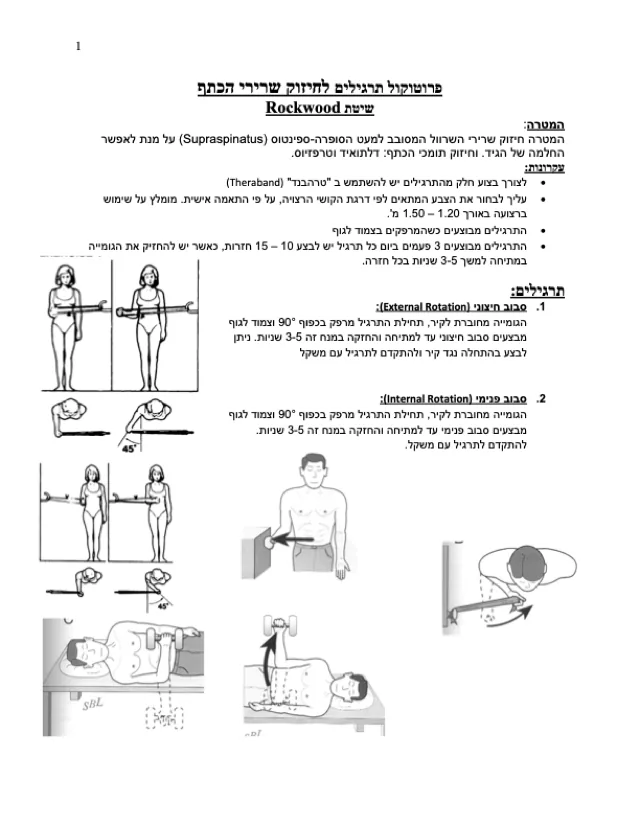 Official protocol documentPage 1 of the full protocol, in Hebrew (PDF).Open the PDF →
Theraband colors – levels of difficulty
| Color | Level |
|---|---|
| Yellow | Very light (beginners) |
| Red | Light |
| Green | Medium |
| Blue | Strong |
| Purple | Very strong |
A band 1.20–1.50 m long is recommended. The color is chosen individually.
When should you contact a doctor?
- Fever above 38°C
- Pain that is not relieved by painkillers
- Heavy discharge from the wound
Further reading from leading medical sources
For readers who want to go deeper, here are reliable sources from the American Academy of Orthopaedic Surgeons (AAOS – OrthoInfo):
- Rotator Cuff & Shoulder Conditioning Program — OrthoInfo (AAOS)A structured exercise program for strengthening and rehabilitating the shoulder and rotator cuff
- Conditioning Program — full exercise guide (PDF · AAOS 2025)The illustrated exercise booklet to download and print – PDF file
External sources in English · open in a new tab